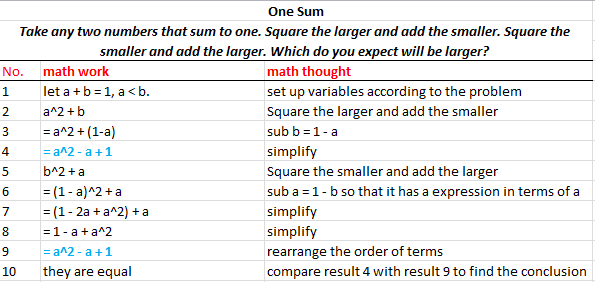
Could you, and would you, run a SNAP Math Fair in your practicum high
school? Why/ Why not? If you can imagine doing so, how would you adapt
the Math Fair to your school and classes, and why?
The purpose of a math fair is to let students feel
the beauty of mathematics. To do so it engages students in mathematics with
extra-curricular materials that are interesting (not boring) and participatory,
encourages students to solve problems in a non- or low-competitive level, and
gives students opportunities to present their findings.
I would, and I could run a SNAP math fair in
Churchill Secondary. However, I may encourage students to include some problems
from pokers, card games, board games, chess, GO, Sanguosha, etc. Most of the
math problems in the booklet are math-related, but they are strategic games as
well. For some people feeling these problems are tooooo mathematical, games
with more strategic features can be used.
By the way, technology can be used in the fair as
well.
So far I am not quite sure how I would run the fair.
I will observe more fairs and then prepare my own. But no doubt, a
math/strategic game fair is a good idea to involve students.
MOA Math Fair
Several interesting things I like to mention about the math fair in MOA.
First, students were enthusiastic. Sissi and I tried all the problems with students' invitations.
Second, problems were well-stated and mathematically enlightful, although some problems were mathematically identical under different scenarios.
(a) One interesting problem was to find a "winning strategy" of a game:
Two players in turn take one or two ships away from the ocean. There are 6 ships in the ocean. Whoever takes the last ship away wins the game.
Another similar game was to remove trees from land.
All the two games shared the same mathematical concepts. It required students to think backward and understand some number theory. The senarios were interesting as well: the ocean one can be considered as an "environmental" topic, while the second one reflected the terrible result of over-lumbering.
(b) Another interesting problem is a changing-position senario. There are seven places placing along a line (consider it is a number axis from -3 to 3, namely, -3, -2, -1, 0, 1, 2, 3). Three birds occupy -3, -2, -1, while three ducks take places of 1, 2, 3. Birds and ducks want to switch positions, but a bird can only move to a larger number, while a duck can only move to a smaller number. A place cannot be occupied by a bird and a duck at the same time. All the animals can move to an empty adjacent place, or jump above another animal to the next empty place.
Studetns mentioned that this problem had taken them three days to be solved. And there was another similar problem but different animals.
(c) There are 9 objects with identical shape. One of them is over weight. Here is a scale that one can measure if the weights on both sides are equal or not, but it cannot measure the exact value of weight. How many times can you find the over-weight object?
The smallest number of trials should be 2, but the student serving this problem believed it to be 3. The good thing is that I only did similar problems on book and in mind, but I have never tried it with my hands! Wonderful!
All in all, students were all engaged and the math fair was fun! Enjoy the happiness of using/learning mathematics. This is the main goal.